
Archive | writing out loud RSS feed for this section

Daddy’s Not-So-Little Girl

15 Apr

This opinion piece was originally published in this month’s edition of India Currents magazine. I’d love to hear your thoughts on the subject!

~

One of my strongest memories of childhood is from age 9, where, propping my eyes open with thumbs and forefingers, I willed myself not to doze as I waited behind metal railings for Daddy to emerge from the airport. I had never been on a plane myself. Foreign travel was many years away. But none of that mattered because I was finally going to be reunited with my beloved parent after a two-month gap. When he came into sight, tall and French-bearded, I dashed straight into the exit aisle, head first, running as fast as my chubby legs would carry me, pigtails bringing up the rear. Thankfully skirting the trolley, I hurled myself into his belly, determined not to let go.

I’ve never been one for diplomacy in declaring love. I had a favorite parent and made no bones about it. I have a favorite friend and think nothing of calling her my bestie in the presence of our other close pals. I even have a favorite spouse, but he says that isn’t applicable, since he’s the only one who has ever occupied the position. Circling back to what I meant to share, yes, I was always Daddy’s girl, and remain so to this day.

My discomfort with the tag begins with the insertion of the word “little.” When grown women voluntarily declare juvenility, it is cause for concern. It signals a refusal to mature, a hankering for continued protection, and the rejection of the possibility of a loving adult relationship with your parent. We all grow up. Most of us even manage to add maturity to the checklist. We spend the maximum chunk of our lifetime in adulthood. Who, then, are these women who declare their undeveloped-in-some-aspect status and are they fully aware that it entails connotations of emotional stuntedness?

Some are those who lost their father/father-figure early in life, leaving a gaping hole in their emotional development. I am truly sorry for them and understand at some level the need for comfort and protection. Then there are those who, despite having a living father, go all cute and helpless in his presence and think it is perfectly okay to exhibit this inappropriate behavior. We beat men up for being tied to their mothers’ apron strings. They are called sissies and contempt is showered upon them, because adults are expected to operate within the parameters of healthy, mature boundaries. Why then is it perceived as culturally acceptable to have women in their 20s, 30s and 40s openly declare that they will always be little girls to a parent or parental figure? Does one have to be a “little” girl to spontaneously hug one’s father and laugh over childhood memories? And more crucially, how healthy is it if your parent still sees you as a child when you have one of your own? You’re probably thinking “this is socially acceptable across pretty much all of India” and you’re right: infantilizing one’s adult children is a predominantly Eastern trait, but in the case of Daddy’s “little” girls, this phenomenon seems to cut across cultures with the stereotype readily accepted and fostered in Western society, a classic example being grown-ass Jewish-American Princesses (JAPs).

As women in an era that affords increasing freedoms and gender neutrality, how relevant is this “little girl” position and why do we even want it? Are you less of a daughter if you share a loving, positive equation that includes talking about your work, your dreams, and those cookies you charred in an adult manner? Do you see no need for self-determination when Daddy dearest is around to arrange it all? Even if you did not have a positive paternal role model during your childhood, how does clinging to a false image benefit your growth as a fully functioning adult human being?

In Dr. Peggy Drexler’s book Our Fathers, Ourselves, she points out that daughters feel more at ease around their fathers when they are treated like intelligent beings and not delicate playthings. Perhaps it is easier to continue in the rut of set relationship patterns. But there is pleasure in realizing your father, whom you looked up to as a child, now listens to your thoughts about the upcoming elections. There is the joy of explaining how you tweaked that favorite family recipe. There is fun in trading musical experiences and recommending new reads. There is even an undeniable pleasure in bashing the relatives, now that you can see their follies through adult eyes!

Eric Berne, of Transactional Analysis (TA) fame, states that we operate from three states: Parent, Adult, and Child. Our relationship patterns usually crystallize over time such that we tend to relate to one another in predominantly one state over another. Some, for instance, will react to a spouse as a child or a parent. Plenty of parents, out of sheer habit or perhaps not knowing any different, will respond to their adult children in parent mode, occasionally deploying child mode as a guilt trip. This unhealthy scenario does women a disservice, helping to enforce stereotypes of weak, helpless womanhood. There is no shame in being weak or helpless when you truly are, but a lifetime of interaction on those lines can only harm you.

It is true, ladies. Our fathers are frequently the first male loves of our lives. But then we GROW UP. Like ALL healthy human beings. And the evolution of our loving relationships is the best indicator of much-needed maturity. You’ll always be Daddy’s girl. But you haven’t been little for a really long time. Take ownership of your adulthood. Embrace its unique perspective. You will find that your daughterhood won’t diminish because of it.

Child Sexual Abuse Awareness Month: CSAAM 2014

31 Mar

Would you believe how the first three months of the year ganged-up against us, racing right by and paying no heed to our gasps?

Reluctantly or otherwise, this brings us to April, and another year of Child Sexual Abuse Awareness Month on the blogosphere.

CSAposter

Again? Yes, again. It hasn’t gone away, has it? Neither should your attention.

Please direct it to this page, and learn about our partners, the problem, and the crying, aching, screaming need for AWARENESS.

Share the URL with your friends: Facebook, Twitter, email, your own words over a cup of coffee. Whatever your method, get talking.

Join Twitter chats that address the issue from various professional angles (I will be doing one and will update time and date details on this post).

We want to hear your stories. If you have none to share, lend us your ears because the world has far, far too many.

Thank you yet again, lovely readers, for sharing with me this month of personal experiences that break our hearts and make us want a better world for our children and their adult avatars.

Lizard’s Tail

25 Feb

It’s fascinating to watch the morphing of an entity that has been severed or disconnected from a larger part. Whether it is a country partitioned from its old composite avatar or a person who forsook their religion because of marriage, they seem to be propelled toward polarization, creating identities more extreme than otherwise necessary. This has happened, I chose this, now I must take a stand and be different, stand up for my act of separation, perhaps even justify it. Ignore the sameness. Ignore the city streets with approximately the same amounts of garbage, because there is a heightened sense of Another Religion in the air. Ignore how nothing has really changed about your food, your clothes, your very colloquial exclamations, because now you are Married Out.

While some are compelled to change, feel an obligation to become The Other, a few dig their heels in and stoutly choose to be driven by factors that prod us to take these steps. Still fewer others fling themselves between identities, but who likes the dissonance that produces? One over the other is easier, safer, infinitely more convenient than duality.

In the rarest of cases, it is a personal blessing for those who never really belonged to one space to begin with. A chance to seize the molding clay of circumstances and fashion from it at will. Those who say I will not be driven, pushed, compelled. Who acknowledge that many factors may change external situations, but we choose to renew our identities-or not. Even as I hear the constant drone of “change is ever-shifting” in the background, I am intrigued by the endless buffet of change, what whets its appetite, what platters we pick from, and the choices that fill our senses and identities, keeping us alive, moving us forward, nurturing stability, dulling our nerve endings into half-burying ourselves into the ground and sticking Velcro-like to the comfort of our original realities.

What do you fashion for yourself? Does your sky take on a different hue? What drives you to be still or shed layers? Do you see it as a necessity, inevitable, or a painful metamorphosis? When you throw off your tail, does your yoke get cast off with it? Or is it warmer to wrap a familiar milieu around your being and rock it close all the live long day?

I thrive between answers. So from the looks of it, I am in no tearing hurry to grab the nearest available one. Let me go arrange a bowl of flowers in the meantime. Nothing like petals and stems to dissipate a whorl of question marks. 🙂

The Season of Rust

23 Dec

I wrote this post 2 months ago, but clean forgot about it in the non-stopness that has been life lately. Apologies for the delay, especially since it was a time-relevant subject, but without any further delay, here it is.

~

Northern California has two seasons: sunny-and-pleasant, and sunny-and-mildly-chilly. And oh, three- drops-of-precipitation-before-the-sun-colonizes-the-sky-again. For about 2 and a half days a year. Last week, we awoke to Season Two. And felt a delicious shiver on throwing off our down comforters and savored that warm, milky coffee a teeny bit more.

The leaves have changed color. Like an earnest child who can’t quite catch up with his peers. You love him for trying, but you know he’ll never make the League of Sporting Champions.  He’ll always be the one with “Good effort” on his report card, and a slightly patronizing smile from his teacher, glory reserved for his siblings further east.

The pumpkins are out in all their plumpness. And if, like me, you enjoy the national color of this blog, you’re in for a treat, because it’s everywhere.  Crunch through piles of raked, dried foliage in your chocolate suede boots, wonder whether you can sneak in a swim for a few days more, and smile as your favorite hot drinks make a comeback at Starbucks. Apples and caramel abound. The soups are hearty, there are spices in the air, and ovens begin their annual overtime. Suddenly, sugar is a friend.

But this time of year isn’t special just for what it offers. It carries the promise of what lies ahead: Halloween costumes and Bingo night. The sparkle of Diwali, the colors, the lamps, the family time, the mithai. Thanksgiving, our annual mini-moon, and another year added to our legal partnership. Bringing home our Christmas tree, stringing lights while drinking eggnog and spiced cider, picking out new ornaments to add to our collection, watching our holiday traditions—The Nutcracker and A Christmas Carol—baking brownies and hosting our annual Christmas gathering. Playing Holiday Radio until it comes out of our ears. Singing hymns into the clear, starry night. Spending time with loved ones, exchanging gifts, Christmas Day dinner and the food coma after, and festivities until another year is properly welcomed. All of this, permeated with that delightful winter chill that has us wrapped in light scarves and jackets, with not a snowflake in sight.

This year, our already-busy season is topped with two special family events. The excitement mounts. We trade updates about outfits and coordinate schedules. Calls fly across the globe as we prepare for visitors and make lists of places to take them.  Much lies ahead. We bubble with plans to celebrate. But for now, I’ll enjoy the moment. Watch another leaf drop and the season turn, as I grab the chance to stand still. The pleasure of anticipation is half the fun. But the other half lies in letting the future take its time.

Here’s a toast to the season of rust. As the earth evolves, so must our destinies with it.

Opposes/Supposes

11 Dec

I shared this with close friends exactly a year ago, and the question still haunts me, so I thought I’d put it out there for you guys to shed light on. Not your typical cheery holiday fare, I know.

~

American rhetoric is littered with war words on a daily basis. The nation’s lexicon is so charged with conflict–the war against smoking, the battle against cancer, the fight to save a marriage–that every act, no matter how innocuous, is verbally militarized. So deeply entrenched are these cultural references to violence, that those raised in the country barely appear to notice. Is there anyone else who sees this? I can’t be the only one! Why don’t we question it? Is there any literature or research on this that would help me understand the phenomenon?

Foam Warrior

6 Oct

You may be a gentle soul, but let it not stop you from rising to life’s challenge when it arises.

Fight, even if only that you may reclaim your gentleness when the war is over.

The New Doormat

1 Sep

“Our family doesn’t have a head.

Only an expanded heart and two bums, typically waggling in time to a tune.

Patriarchy is best parked at the door.”

~ A sign I’m considering putting up at the entrance to our home

It Doesn’t Quite Click

16 Aug

Perhaps there is some truth, after all, to the wisdom of non-camera-savvy people. When they stare into a foreign object and let it capture the physical essence of who they are, perhaps they know better than us to be in the moment, be real, and not put on an act of pretending to be happy. Maybe they want to be remembered for their true feelings that day, if it means staring grimly, soberly, and not splitting their faces into socialized smiles to deceive an audience into believing their lives couldn’t possibly hold more joy. Maybe there is some truth to their presentation. In a way that will never be in ours. Unless, of course, we go through our days posing and toasting, all flung arms and side profiles, best face forward, like we never scrounge in pyjamas or have a bad mane month.

And maybe there is wisdom in not holding on to those images of ourselves, seconds of moments past, when we are ever-changing, eternal. The you that was doesn’t exist anymore. And yet we chase it down, grapple it to the ground, and pin that wave upon the sand, content with mere froth.

No judgment here, just an observation. Think about it. And share?

Play Review: Vande Mataram

19 Jun

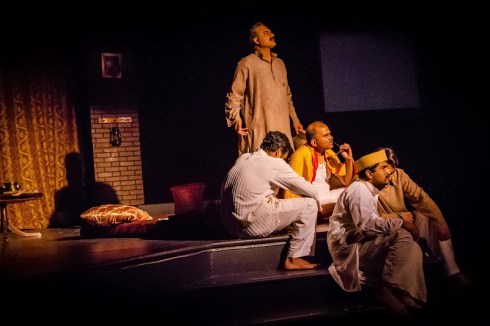
When we moved to the San Francisco Bay Area two and a half years ago, our aunt introduced us to Naatak, a local theater and indie cinema company with a reputation for interesting productions, well-executed scripts, and great performances. Naatak’s plays, enacted in Hindi (mostly), English (sometimes), and Tamil (infrequently), with supertitles, have used the scripts—both original and adapted— of stalwarts such as Bhisham Sahni, Satyajit Ray, Vijay Tendulkar and Girish Karnad. The play in review, Vande Mataram, was written in 1997 by one of Naatak’s mainstays, Sujit Saraf. And if you’re wondering why I’m blathering on about the writing piece more than any other element, it is because this wonderful performance that we enjoyed this past weekend was the product of a strong, nuanced, beautifully written script that was satisfying and whetting in equal parts.

Vande Mataram opens the night before August 8, 1942. For those of you not familiar with the Indian freedom struggle, this date marks the launch of the Quit India movement. With Japan advancing rapidly and successfully through the countries east of India, and Britain’s increasing need for Indian military and resource support to fuel its WW II efforts, Indian leaders finally had a playing card and employed resistance and civil disobedience tactics to make the Empire take heed of their demands. It is here that the storyline departs from the black-and-white textbook version of history that would have us believe it was Gandhi vs. the British Raj, Independence vs. Colonialism, and Honor, Freedom and All Things Good vs. Exploitation, Repression and Popular Sub-continental Narratives.

Naatak picture

[Photo credit: My resident photographer, the one and wonlyderful Boy.]

Interestingly, the production whose byline reads “A play about greed, gunpowder and Gandhism” manages to skillfully remove Gandhi from center stage and relegate him to the footnotes. Based on the Keezhariyur bomb case in Kerala (erstwhile Malabar), it introduces us to a cast of characters that plot to blow up a bridge in Patna along the same lines and draws us into a web of their motivations, personal histories and politicking. Six men, each playing his part superbly, embody a motley crew of a Colorado-trained professor, a local Congress committee head, two Marwari businessmen (and feuding brothers), a restaurant owner and a former soldier-turned-bank-guard with “a chudail who dances in his head”. Together, they debate, squabble, negotiate, reminisce, manipulate, plot, re-plot and maneuver the circumstances to their individual viewpoints and advantage, and through their synergy, we are rapidly transported from a macro picture to a microcosm of their personal greed, ambition, humor, and failings. We relate. We associate. We recognize. Sitting in a darkened theater on a sunny California afternoon 70 years later, the audience identifies the common human denominators that bind us all, and it is to the scriptwriter and actors’ credit that they make it so easy.

Then there is the plot. Moving at a fair pace, this dialogue-heavy play never feels a minute too long, and with a well-timed interval, leaves one waiting for the second half. Will the plot succeed? Will they be caught? Will a difference be made to the freedom movement? In spite of knowing how it turned out, and witnessing the imperfections of its characters, Vande Mataram is a play that makes you root for them, their well-being, desires, and safety.

The Sanskritized Hindi is true to its period, which has us modern mortals glad for those English supertitles. The costumes are authentic, and the set is simple and effective. Not intended to be a high-cost endeavor, Naatak’s production is nonetheless neat, efficient and a job well done. This genre of theater is what they do best and would do well to focus on in the future.

The play leaves you pondering about the multiple layers of sentiment, motivation and issues that form a complex but never tedious package, and it is to the team’s credit that they do not aim to dumb down any of it. For so many of us fed a simplistic version of one true representative of the people versus the British Crown, it is a gentle reality check about the multiple voices and opinion streams of the period. It invites the audience to take from it what they will, at a level and depth they are comfortable with. For me, an idea that has me toying around with it in my head nearly a week down the line and likely to continue, is a worthy one.

Not your typical treatment of nationalism, this. Which, incidentally, is what makes it a winner.

Go watch it if you live in the Bay Area. I just got even gladder that I do. 🙂

Mere Paas Maa Hai (aur dimaag nahi)

12 May

Happy Hallmark-dictated-skyrocketing-sales-great-for-the-economy Day.

Because my Mother’s Day is October 27th, the day I celebrate the something elseness that is the lady who birthed me and taught me to be sensible, cautious, forward-thinking, hygienic, feminist, organized, articulate, logical, and unable to stand by and just watch life happen—in her own image.

If we want to celebrate a generic Mother’s Day, on the other hand, I would need to include a hell lot more people who nurtured and mothered me–an aunt with a soul connection, another who is my confession padre, my grandmothers, both biological and adopted, my best friend and rock, and an erstwhile boyfriend, who despite being a clueless 20-something himself, could teach every woman who’s ever pushed a human out of her a thing or two about unconditional love.


If our mothers are indeed so special, how come we bunch them up, assign them one universal day filled with hoopla, bells, and whistles, and move on before the overpriced flowers have wilted? Of course they’ll lap it up. Hell, after chronic sleep deprivation, poopy diapers that even they can’t claim smell like roses, and the sheer relentlessness of attending to needs for twenty plus years of the human life span, they’ll lap up far less pleasantness with a bring-it-on gratitude. But are we really being fair to them, with this tacky song and dance affair? Or is it easier to just swipe that credit card, fall in line, and wholeheartedly buy into a greeting card company’s idea of banging profits?


To the mother who taught me to think: I love you every day. But on October 27th, I will celebrate you. Because you’re MY mother, not just A mother. And because you’re smart enough to recognize the difference.

~~~

Edited to add: Here’s a mother of multiples, sharing her point of view:

http://vidyazworld.blogspot.com/2013/05/mothers-day-hype-or-humbug.html